Hyper-fast, lightning-reflex arcade evasion are some of the most thrilling games you can find on mobile. The simple controls translate well to touch, and the seconds-long survival fits the platformer perfectly. The psychedelic rotation of Super Hexagon. The constantly-changing levels of Boson X. And now the insane screen-shaking speed of Barrier X.
An expanded version of an freeware 2014 title, Barrier X puts you in control of a vessel rocketing through an endless expanse at insane velocities, as white barriers appear with alarming speed. The ground beneath your craft turns orange as a visual warning of an upcoming barrier, giving you just enough of a warning to shift right or left and evade destruction by mere fractions of a second. It's breathless thrilling action, as barriers fly past, barely a blur as you rocket onward. Survive for 15 seconds, and your reward is to go faster, an increase in speed. 30 seconds, and you unlock a new level, while 60 seconds masters that level, a true test of reflexes and reaction.
That alone would make for an exciting arcade game, thanks to Barrier's slick polished design and wonderful sense of speed. But each of the game's seven level introduces something new. Blue blocking barriers that must be dodged in a specific direction. Green barriers that you need to pass through rather than avoid. A rival craft that you need to shoot down and avoid its fire. These elements make Barrier X's gameplay that much more interesting and intense and keeps what is essentially just moving left and right from feeling repetitive.
Barrier X is available to download for free, with a single in-app purchase to remove ads. You can find the game on the App Store and Android; a PC version is currently seeking votes on Steam Greenlight.
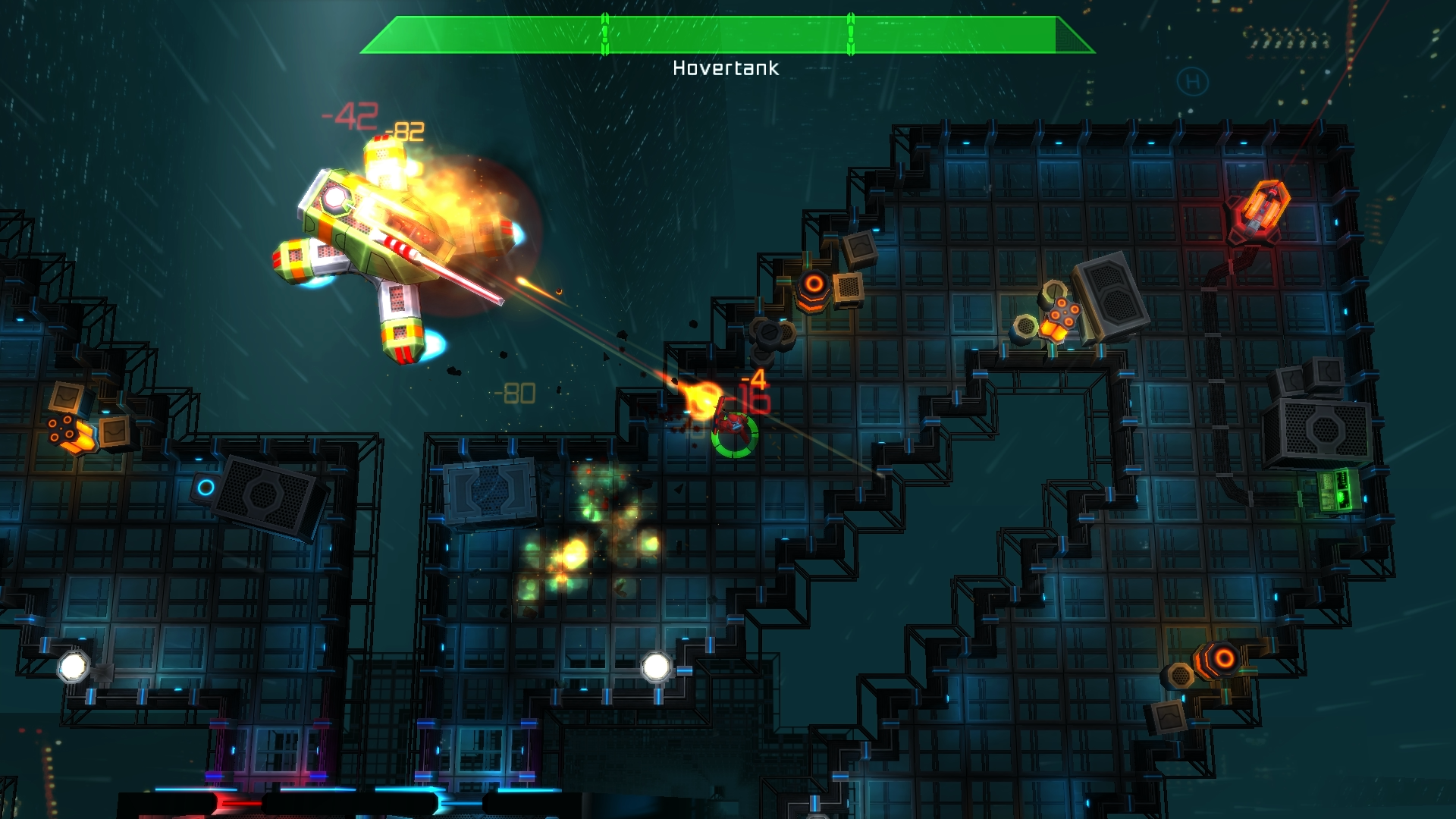
Two years ago, 10tons surprised me with their blood-soaked dual stick Crimsonland, a furious shooter that throw massive hordes of enemies at you and mixed up the action with weapon unlocks and perks. Neon Chrome follows the same basic structure of dual stick action, unlocks, and sci-fi, but with a new focus on cyberpunk megacorps, stealth, and a more cautious approach before the explosions start.
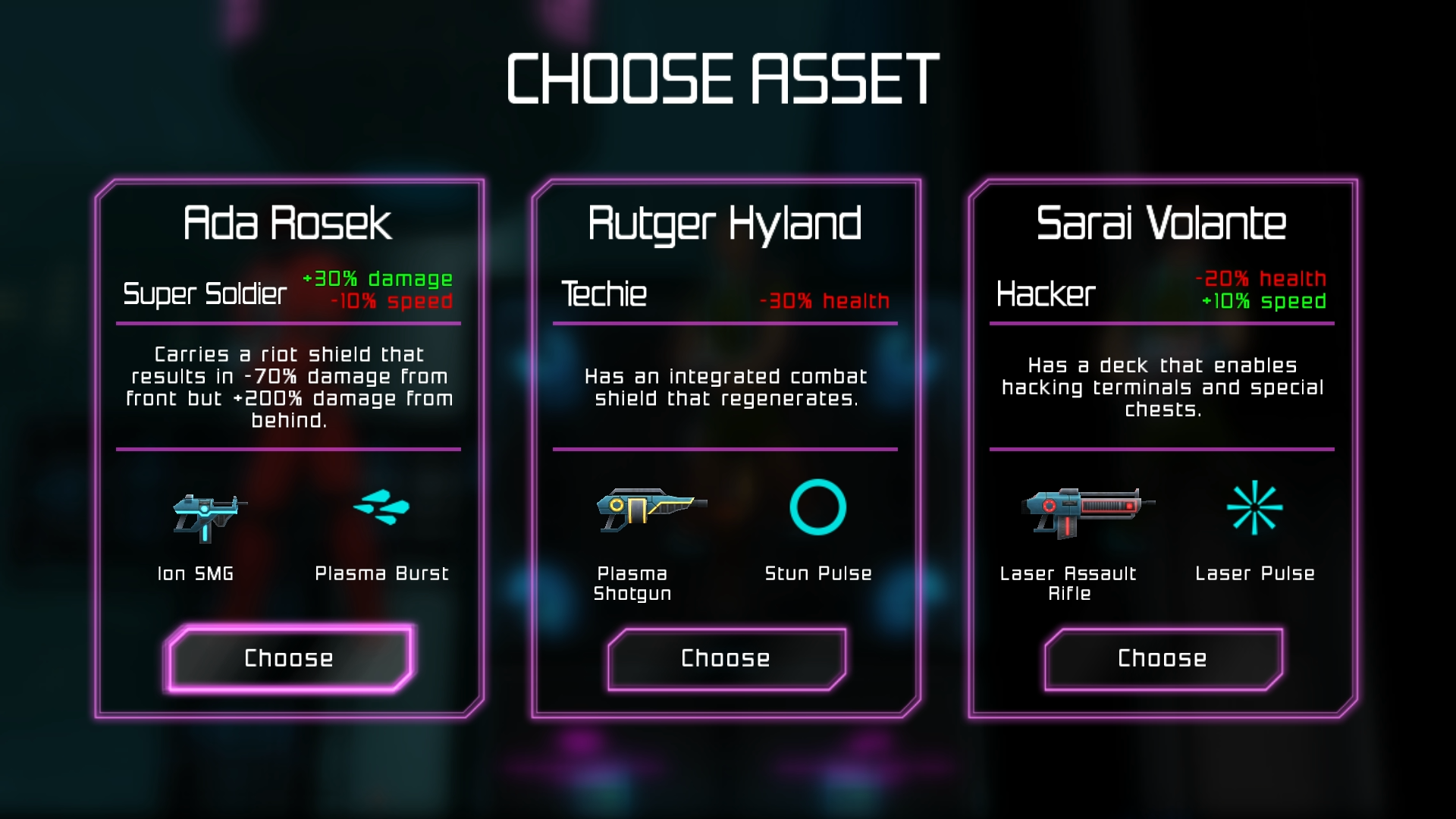
Waging war against the massive tower of the titular megacorporation and its Overseer, you remotely control augmented "assets", divided between classes like assassin or hacker. As you battle through each procedurally-generated levels, you unlock new cybernetic enhancements, more weapons, and skill buffs, to face survive increasingly dangerous defenses.
I've been playing the beta for the past week or so, and Neon Chrome feels like quite change from the instant non-stop action of Crimsonland. The pacing is easily the biggest difference, as enemies aren't aware of your presence when you first arrive, If you're a hacker, you might be able to disable some lasers or turrets, while an assassin with a cloaking augment could even the odds before going on the offensive. New enhancements, ranging from an armed drone to stronger melee and increased speed, can be chosen as you move between levels, while more offensive power-ups let you unleash area-clearing lasers and missile strikes.
You'll need those tools because the enemies in Neon Chrome are more advanced than the charging hordes of Crimsonland. Rotating turrets, mines, and security drones defend rooms, and heavily-armed soldiers patrol, wielding shotguns, machines, or even riot shields which force you to flank and attack enemies' exposed backs. Alerted foes can call in devastating reinforcements that only give you a couple of seconds to prepare, and powerful bosses will test your shooting prowess.
Neon Chrome is still in beta, and will be releasing later this year. You can learn more about the game here.
Title: Super Arc Light Developer: No Code Studios Platforms: IOS Universal, Android Price: $0.99 --- There's almost something refreshing about those pure and simple games like Super Hexagon or Canabalt or any other of those simple-to-control, laser-focused, arcade-y experiences. Super Arc Light is another entry to that list, a radial shmup that only requires a single finger to control but focus and timing to succeed. Super Arc Light's set-up couldn't be more simple: there's a base in the center of the screen, there's a single turret guarding the entrance's perimeter, and there's an endless wave of geometric enemies approaching. It's a formula as old as Space Invaders, presented here in a slick minimalist style, colorful rounds contrasting against the stark black-and-white battleground. There are no extra modes to unlock, no alternate difficulties, nothing to upgrade. Super Arc Light is pure distilled shooting action.
Shooting those encroaching waves is easy as well. Your turret automatically travels around the base's circular entrance; holding down slows time and fires your weapons, while letting go causes you to reverse direction and rotate the opposite way. It may take a few attempts before you get a handle on the one-touch control scheme, but when you do, combat becomes a hectic back-and-forth dance as you swing back and forth to deal with enemies on one side, spinning around to take out a new pattern, then back again to grab a power-up.
As you survive longer, new weapon power-ups are unlocked and added to power-up pool, ranging from the basic forking triple shots to blinking ion beams, horizontal split shots, and gracefully homing missiles. Enemy types are equally varied; single ships that hover around, fast movng x wing-likes that change direction, rotating patterns in the shapes of triangles and squares, large swarms that require quick precise shots.
While the lack of gameplay of modifiers or modes means Super Arc Light might get repetitive after a while, the simple, direct, easy-to-control but not-easy-to-win gameplay makes it perfect for those quick sessions when you need an instant adrenaline boost of action. You can purchase Super Arc Light for $0.99 on iOS and Android.
Title: Abzorb Developer: Gerald Kelley Platforms: IOS Universal Price: $2.99 --- It's been six years since Tilt To Live showed how to do tilt controls well on mobile, and three years since its sequel expanded on the strengths of the original. Tilt-controlled games can be difficult to nail, but the new arcade puzzle Abzorb might be the best I've played since Tilt To Live, featuring both responsive controls and surprisingly varied twists on its simple concept. Abzorb is quite straightforward. You control an arrow, sliding around the screen to absorb blue energy from orbs. To collect the energy, you need to stay close enough that the orbs are in the radius of your triangle, but not close enough to actually touch. Meanwhile dangerous red orbs drain the level's clock if they enter your range, making Abzorb a game of fast-paced evasion and puzzling as you figure out how to gather each level's blue energy without running out of time.
If Abzorb was merely an endless game revolving around those mechanics, it would still be a fun game thanks to its stylish minimalist aesthetic and surprisingly tight tilt controls. But Abzorb layers on a vast range of additional mechanics and tricky level design to create a unique polished arcade puzzler.
Some orbs grow or shrink your absorption radius. Other orbs are chained together and inactive until drained of energy. Other orbs form barriers around you, forcing you carefully push and shove the sides to move across the screen, Special gates change the color of orbs that pass between them, Many more mechanics await, as well as the additional challenge of completing each of the game's 65 level as fast as possible for the best scores.
Abzorb is available for $2.99 and has no in-app purchases.
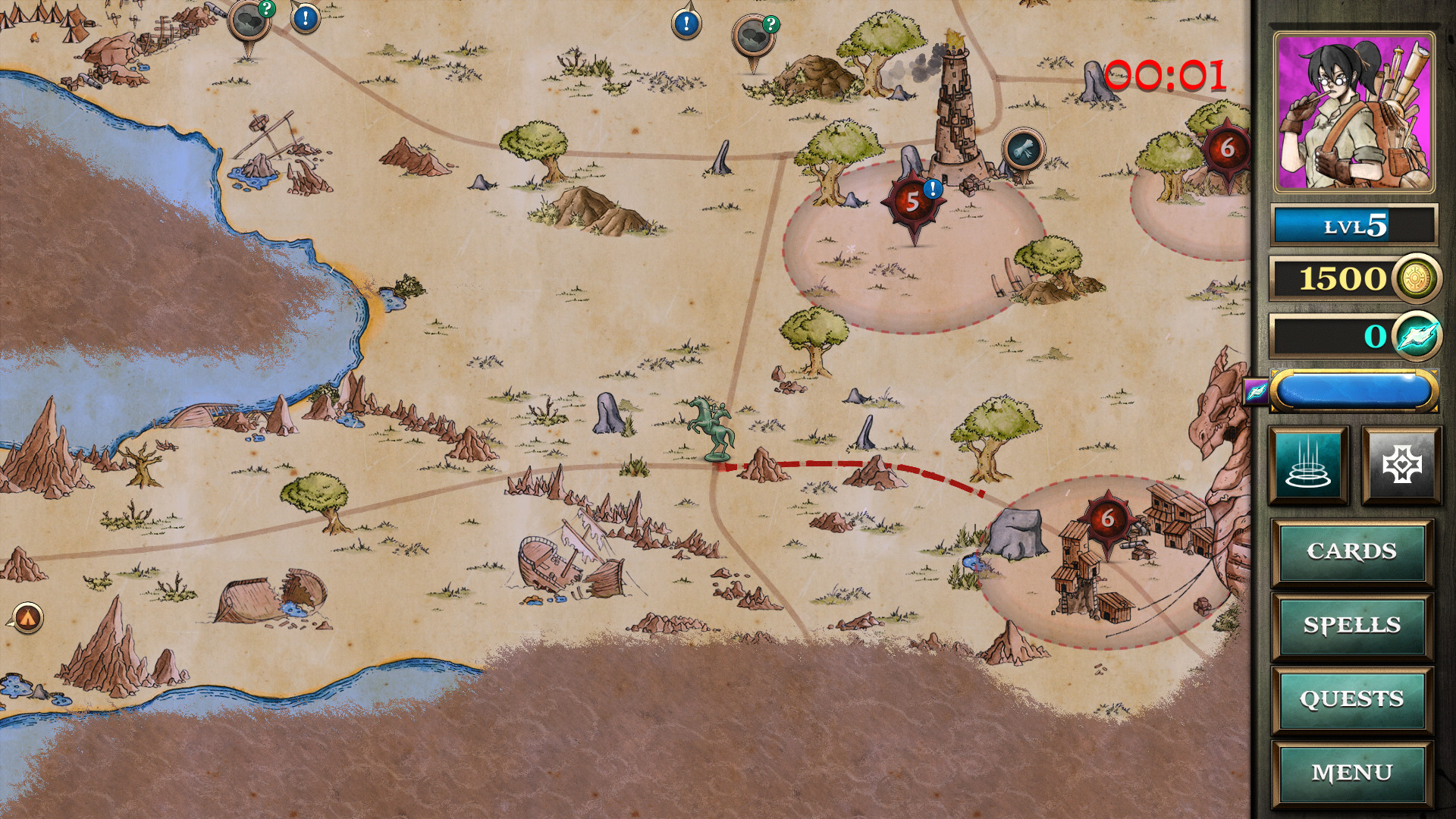
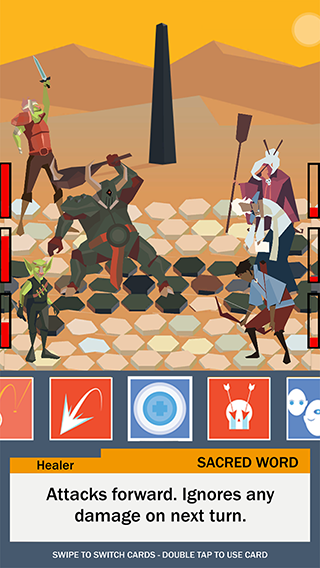
Title: Decromancer Developer: Unit9 Platforms: IOS Universal Price: Free --- It can be easy for mobile games to slip under the radar. Given the sheer amount of releases each week, decent games can come and go without ever catching many eyes. Decromancer first released in 2013, afterwards making its way to Android and Steam, I only discovered the game last week and completely surprised by its tactical card combat and wealth of content.
Decromancer's story is simple: explore a enemy-filled map, help a stranded diplomat to get home. But story isn't the focus here; it's the game's tactical combat and in that aspect, Decromancer shines quite brightly.
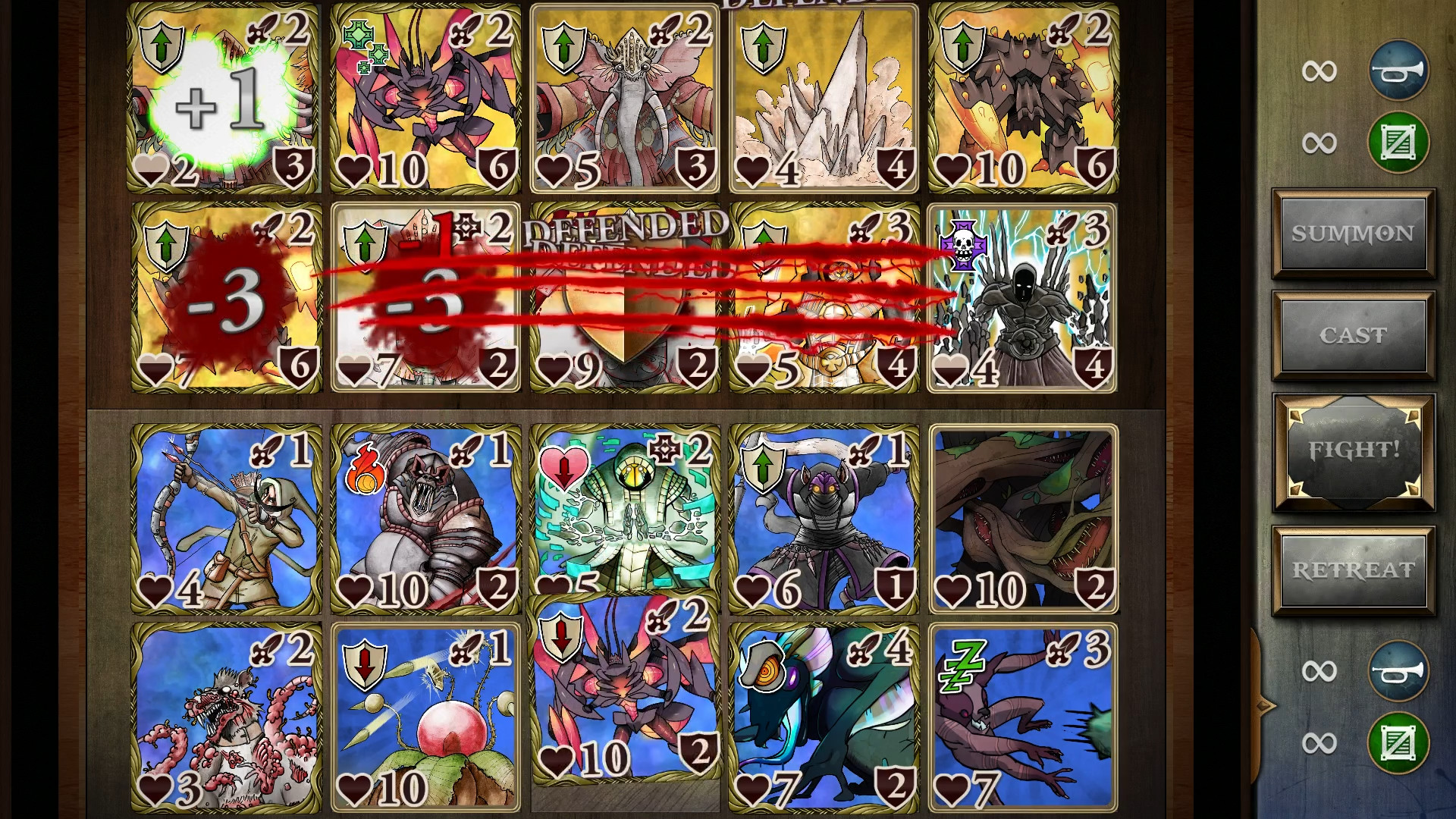
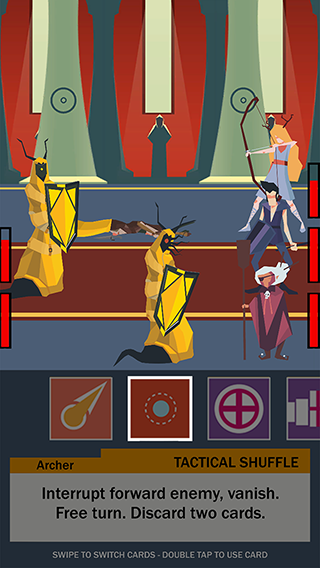
Encounters takes place on a four-by-five grip, with enemies controlling the top two rows and you controlling the bottom two. Each turn, you can draw three cards from your deck. So far, kind of standard. But while the mechanics are akin to the wealth of other card battlers, the actual combat is strategic and all about positions and abilities. Each unit has a specific range of effect and special skills: spearman can hit two tiles in one blow, archers can randomly target three tiles, healers assist all adjacent tiles, and so on.
This allows an incredible amount of tactics. Protecting your front row with siege shields while peppering an enemy's front with protected spears. Place powerful snipers in your back row, while reinforcing your front line with healers and swordsman. As you gather more powerful cards and upgrade cards already in your deck, the strategies only grow more complex, allowing you to stack status effects, attack ranges, and buffs to annihilate your foes. An arsenal of spells further expand your tactics, letting your unleash a horde of rats, call down meteors upon your enemies, increase your ranks' defense for several turns, and more.
Of course being a card game and free, Decromancer is likely to cause some to be hesitant, but it's surprisingly fair. There aren't any card packs to buy, and while you can purchase gold or shards to heal your cards, the game rewards you with both frequently. By the time you're facing stronger factions, you'll earn thousands of gold and dozens of experience points per battle, letting you continuously upgrade your cards and gather new ones from merchants. And while the early game can be pretty grindy, the constant dripfeed of new cards and unlocks and the satisfaction of decimating lower-level foes with your superior tactics and powerful cards provides a good push to keep playing.
Decromancer is available for free. You can also find the game on Android and Steam.
Title: Knotmania Developer: 2 Think Games Platforms: IOS Universal Price: $2.99 --- If you've played Zen Bound or Shadowmatic, you're already familiar with the feel of Knotmania's gameplay. A relaxing atmosphere and tactile mechanics make Knotmania an enjoyable game, but the sentient alien entities that you untangle make it unique. Knotmania revolves around the simple premise of untangling knots. Multi-touch controls lets you pull apart strings and twist, drag, and rotate with ease. But those fibers aren't static; instead they're living creatures, worm-like beings that flex and coil and react to your touch.
It may seem like a small change, but the notion of manipulating living creatures gives Knotmania its weird quirky charm. Each level begins with a twisted knot to tackle - sometimes a single worm, sometimes many entangled with each other - a calm relaxed mass indifferent to your presence. Begin tugging and dragging and, as expected, they resist and twist away, moving in slow graceful movements as if through water or in zero gravity. Maybe one worm will try to wrap around and wrestle with another. It adds an engaging vibe akin to an unearthly nature documentary to what's a relatively simple format.
Knotmania includes 76 levels, each one featuring a colorful pairing of room and strings. The oddly textured environments enhances the alien atmosphere, and seeing the shadows of the twisting, flowing worms against the backgrounds helps cement the sense that these are living physical things in the environment.
While the core gameplay is quite relaxing, there is an element of challenge in completing the levels under a time limit, as well as the optional goal of using the fewest amount of touches. An upcoming update will add a Zen mode that removes the timer.
Title: Swapperoo Developer: Fallen Tree Games Platforms: PC, IOS Universal Price: $9.99 (PC), $2.99 (IOS) --- I'm not the biggest fan of match-3 puzzlers outside of the genre hybrids like Hero Emblems and Puzzle Quest. So it was a nice surprise that I enjoyed Swapperoo as much as I did. Although, perhaps I should have expected it; Fallen Tree Games had proven themselves with the excellent series of Quell games and Swapperoo evolves the traditional match-3 formula in interesting ways to deliver a surprisingly strategic puzzler. At its core, Swapperoo follows the same principals as any other match-3 game - connect three or more like items on a grid, removing those matched items from the grid, and so on - but that's where the similarities end. The first and most crucial change is that you only move certain tiles on the grid, and furthermore, only move these triangular tiles in the direction they're pointing. This change alone makes matching a strategic affair, requiring planning moves ahead and thinking if or how to move tiles around the grid,
But soon Swapperoo adds more elements into the mix. Each new addition introduces a new hazard or new caveat to the basic match-3 formula. Suddenly you have tiles that explode after a certain amount of turn, ending your game; now every move you make matters. Then you have sawblade tiles that destroy any tile they collide with; careless moves will throw your grid into chaos, but with planning and careful maneuvering, you can use the sawblade to clear the path for other tiles and set up some high-scoring matches.
And those two are only the start. Tiles that needed to be protected, tiles locked in place, and more continue to add new wrinkles and challenges to the puzzles. On top of those unique tiles, Swapperoo also gives you access to three special abilities, to be used at the most opportune moments: moving a specific tile in any direction, increasing the time on the bomb tiles, and completely detonating the grid. Powering-up these abilities require calculated matches, so each use shouldn't be wasted.
The game features both a hefty selection of handcrafted levels, with unique objectives ranging from simply making a certain number of matches to only making matches with specific tiles, and 38 randomized challenges to truly test your skills and offer long-term replay value.
Swapper is available on Steam, as well as IOS; an Android version is expected soon.
Title: Blown Away: Secret of the Wind Developer: Black Pants Studio Platforms: IOS Universal Price: $2.99 --- Besides being quirky and/or having a unique art style, the only definite thing you can say about the games from Black Pants Studio is that they're diverse. From the hand-drawn mirrored landscapes of Symmetrain to the 3D platforming and environmental dicing of Tiny & Bing, each of their games seems to try something different. Blown Away: Secret of the Wind is their newest iOS game and it combines auto-running and fast-pacing puzzling in a charming and colorful package. Hendrik is unfortunately having a bad day. Through a gust of wind, Mother Nature took away not just his home, but his hair too. Now he travels a weird and dangerous world, collecting the pieces of his house along the way. For the unprepared, this land would prove to be an insurmountable challenge, between deadly gaps, roaming monsters, and raging flames, among other hazards. But Hendrik has a unique tool in his arsenal: a pair of teleporting boots, that Blown Away's puzzles and platforming revolve around.
In each of the game's 120 levels, you walk to the right automatically, recharging your boots with each step. Tapping the screen teleports you to that location, even as you're falling to certain doom. The charging element is what turns a relatively simple mechanic into a puzzler. Your boots only charge when you're moving, and you only have a limited amount of teleports, so reaching the end of a level means assessing the level and figuring out where to teleport so you have enough distance to recharge. But distance isn't the only thing to consider; timing is important as well if you want to evade patrolling monsters and crushing sawblades.
The auto-running and boot recharge complement each other nicely, forcing you to always pay attention to the path ahead, thinking of how many teleports you'll need to cross a gap, where you should teleport to and when. Through that simple single-tap mechanic, Blown Away delivers both puzzles on the go and the arcade-y thrill of dodging traps, and it's all presented in a vibrant hand-drawn art style that brings to mind old-style cartoons.
Title: Power Hover Developer: Oddrok Platforms: IOS Universal Price: $3.99 --- Between Temple Run, Subway Surfer, and everything in between, I've been somewhat burned out on behind-the-back runners. It's one of the most common genres on mobile, and in recent years, seems to have been reduced to the format for generic licensed titles. Switch lanes, jump, slide....sometimes it feels like if you've played one, you've played them all. None that I've played have been able to match the variety and style of the hectic Boson X...till now. With its incredibly varied stages and colorful low-poly aesthetic, Power Hover is easily one of the best runners on mobile. The story is simple. The energy to your robot village has been stolen, get on your hoverboard and follow the thief's trail of batteries to retrieve the power. It's merely there to serve as a framework for the fast-paced chases and hazards to evade, and it's in those aspects that Power Hover shines.
Endless deserts where massive worms gracefully arc through the sands. Sea-bound ruins and seaside cliff faces. Tight canyons wracked by seismic tremors and drills erupting from the dirt. Every level in Power Hover is unique, not merely in terms of locations and hazards, but in how the camera seamlessly changes perspective. One moment, you're guiding your robot boarder through discarded shipping containers from high up; the next, the camera swoops in close as you enter a claustrophobic tunnel.
The constantly changing locations and perspectives, even within the same level, makes each stage feel like an adventure, driving you to see what comes next. The hazards along the way are equally diverse, ranging from stationary stones and rusted cars to rolling spikes and saws to lasers. Between hand-crafted stages and endless boss levels, Power Hover offers a surprising amount of variety in every aspect of its gameplay.
The reflex-testing action wouldn't be worth experiencing if the controls weren't tight. Actually, tight is the wrong word. Your hoverboard has an intentional looseness to it, feeling more like surfing than rigid lane swapping. You're always in control, even as as you smoothly weave between obstacles or grind across rails, but doing so skillfully requires timing and looking ahead to prepare for the next section,
Power Hover's aesthetic completes this polished package. Each level pops with vivid colors and interesting sights, whether it's a coastal strait with wind turbines and gulls skimming the water or a massive machine lumbering through the desert.
Power Hover is available for $3.99 on iPad and iPhone.
Title: Devouring Stars Developer: Nerial Platforms: PC, Mac, Linux, IOS Universal Price: $9,99 (Steam), $4.99 (IOS) --- You've waged war on land, air, and sea. And more than a few real time strategy and tactical games take place in space. But in Devouring Stars, your conflicts don't just occur among the cosmos. Here, the cosmos are your weapons, as you wield the stars themselves in a war between celestial forces. As a cosmic being far beyond mortal comprehension, you challenge the might of other cosmic factions among the nebula clouds and black abyss. Devouring Stars's gameplay is relatively simple: gather resources to strengthen your units, capture the enemy's portal, and escape the stage. But simple doesn't mean easy, and there's an array of mechanics and complexities that make Devouring Stars stand out.
While it may be an RTS, the game strips back the complex base and building systems of other titles in the genre in favor of a more minimalist approach. Stars act as resources for both you and your enemies, and there's only a finite amount on each battlefield, forcing you to assess the stage and decide when and where to gather cosmic energy.
Each star gathered makes your units stronger, but strength isn't always enough to emerge victorious. Before each mission, you're able to select a small group of units to bring into battle, compared to the typical RTS method of spawning units during battle. This challenges you to consider what strategy you plan on using and choosing which units best suit your plan of attack. While that mechanic may seem limiting, Devouring Stars' units are more versatile than they may first seem.
By combining two units, you can create a single, more powerful unit. These celestial warriors not only gain increased stats that could boost their movement or their efficiency at absorbing stars, but also have unique abilities that can turn the tide of battle. Your merged units can do everything from teleporting short distances to freezing opponents in their tracks, to unleashing powerful ranged attacks or achieve damaging critical hits.
Devouring Stars may lack the bombastic spectacle of other real time strategy games like Planetary Annihilation and Supreme Commander, but what it lacks in bombast, it makes up for in beauty. Battles in Devouring Stars are dances of swirling particles and flashing color as stars and galaxies become weapons of the gods. It's always satisfying to watch.
Devouring Stars is available on Steam, and recently released on IOS. You can learn more about the game here.
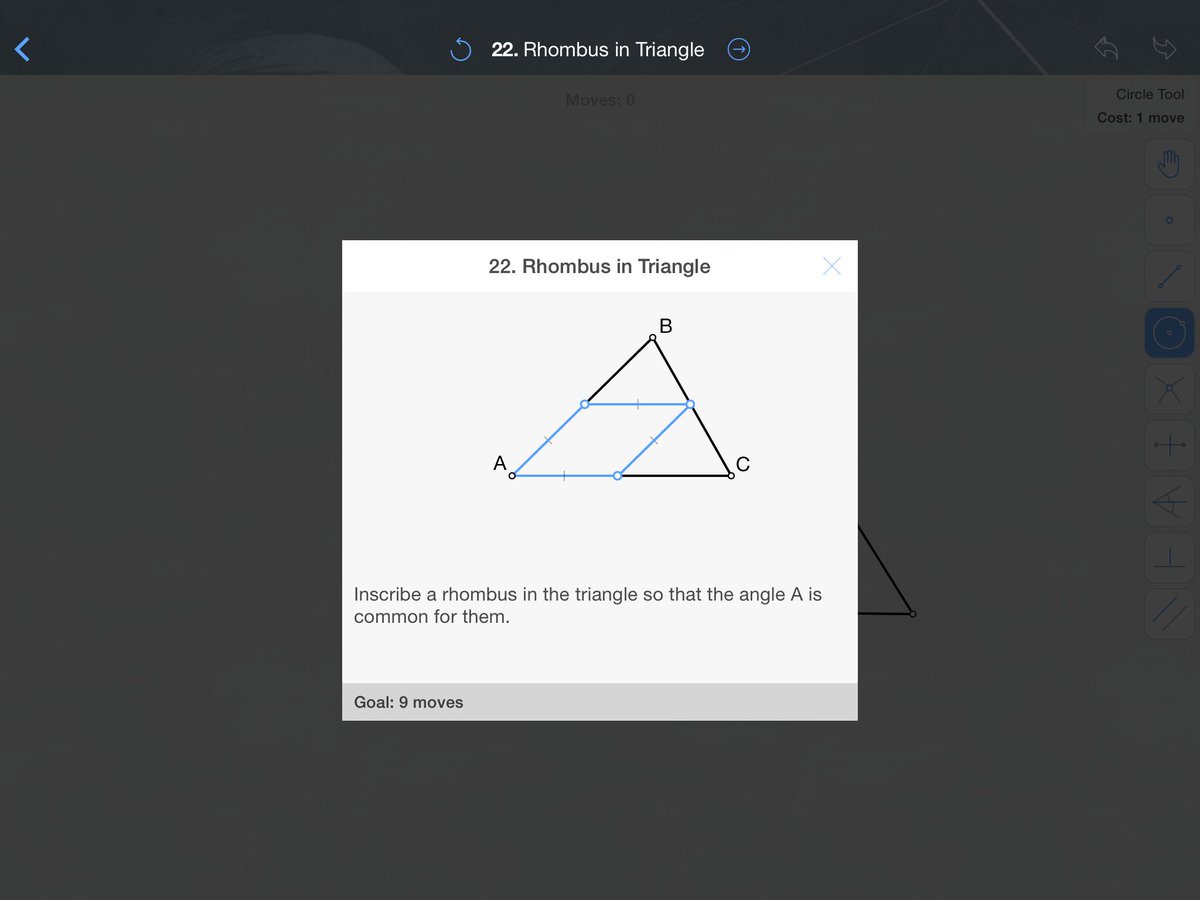
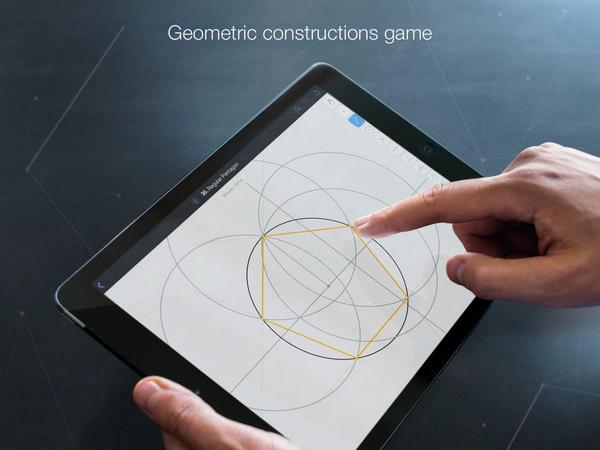
Title: Euclidea Developer: Horis International Limited Platforms: IOS Universal Price: Free --- Math can be difficult and frustrating for some people, and the very notion of math puzzler probably is enough for people to dismiss some games. But Euclidea isn't like most math-based puzzlers; rather than numbers and addition and subtraction, it's all about geometry, constructing figures and shapes. There are quite a few games that feature similar concepts, usually physics-based puzzlers where you need to build supports or structures, but Euclidea distills that idea down its purest, most minimalist form, with an elegant presentation and easy-to-use controls.
Euclidea starts out simple, easing you into its collection of geometric brainteasers by teaching how to create line segments, select points, draw circles. And then gradually, the challenge begins to increase, as you use intersecting circles to create equilateral triangles and perfectly bisect lines.
But the game isn't completely merciless. For several of the more common and tricky actions like bisecting angles and creating parallel lines, once you learn how to construct it once, Euclidea provides tools that automatically perform the action. Thanks to the game's controls and clean UI, the challenges of the puzzles are about figuring out how to accomplish a task rather than in the execution
You'll need those tools, because while Euclidea may be easy to control, it certainly isn't easy. Figuring out to create a perfect hexagon within a circle or trisecting an angle requires you to think ahead, understand how points and intersections and line segments all interact and can be used together. It may sound scary, but the game does a good job at introducing its concepts and making sure you can use them before throwing the tricky challenges at you. Like math in general, Euclidea's puzzles are cumulative, building upon what you figured out before and challenging you to use that knowledge in new ways.
Euclidea is visually sparse, black lines against white, but there's something appealing and satisfying about the symmetric patterns of lines and arches created from your attempts to solve puzzles, how distinct shapes emerge from the mess of intersecting and overlapping figures.
Euclidea is free to download, with only an IAP to remove ads. You can download the game here. And if you enjoy this one, the developer released Pythagorea earlier this year, a similarly geometry-focused puzzler with its own unique twists.
Title: Five Card Quest Developer: Rocketcat Games Platforms: IOS Universal Price: $2.99 --- Between Mage Gauntlet and Wayward Souls, Rocketcat Games is well established as a developer that can develop a challenging quality RPG/roguelike experience on mobile. Now with Five Card Quest, they tackle the turn-based game and deliver a challenging tactical dungeon crawler In Five Card Quest, you select a duo of warriors from a selection of classes, from the powerful support Priest to the dagger-wielding Rogue, and traverse room-by-room through dangerous dungeons. You might find a healing fountain or a merchant or another warrior to add to your party, but more often, you'll find enemies blocking your path to the exit.
Combat in Five Cars Quest is an interesting blend of card game and lane-based strategy, reminiscent of Zachtronics' Ironclad Tactics (however less complex). Your party is one side of the screen, enemies on the other, spread out across three lanes. Each turn you have five skills to use from, a mix of random abilities from each of your warrior's pool of skills, and with each action, your enemies move down the lane, closing in until they're within striking distance.
The combination of random abilities and staggered enemy approach gives Five Card Quest's combat a unique feel and allows various strategy and tactics. Abilities don't just inflict damage; they let your characters swap lanes, freeze an enemy's movement or knock it back to its side of the screen. Some attacks may take three turns to charge up, forcing you to consider how long it will take certain enemies to close the distance to strike. Other attacks do lane-based damage or injury the front-most foe.
You never know what attacks and abilities you'll have at hand during your turn, resulting in tense and desperate strategy as you use whatever's available to postpone incoming attacks, heal and prepare blocks and parries, switch characters across lanes, and so on. Five Card Quest pulls no punches, and a careless strategy will only get you killed more quickly.
Your enemies are just as varied, ranging from shielded brutes to archers and spellcasters. Each area has its own array of enemies, enemies that can stun and poison, among other actions. Friend and foe alike are brought to life on a bright angular art style, giving Five Card Quest a unique aesthetic.
Title: hocus Developer: Yunus Ayyildiz Platforms: IOS Universal Price: $0.99 --- Earlier this year, developer Yunus Ayyildiz released the challenging shape-crafting puzzler rop. Its simple mechanic of manipulating ropes and nodes to mirror shapes was used to offer quite tricky and complex spatial conundrums. Now Ayyildiz's next game hocus is also about spatial conundrums, but rather than recreating shapes, you're navigating them, Each level in hocus presents you with an impossible Escher-inspired structure. You guide a red cube along the perimeter of the shapes, traveling along the odd shapes towards the waiting exit. Forced perspective allows you to travel along planes that appear to touch, letting your cube navigate each impossible maze to reach your destination.
It may sound complicated, but hocus is actually a pretty laid-back puzzler. There are no timers or move counters, so you can access each level at your own pace. While the shapes grow more complex and intricate, the core mechanics remain the same and the game even has a compass that lets you know which directions the cube can move at each junction.
Every new level in hocus is a pleasure to study and navigate, especially if you're a fan of Escher-style illusions and impossible shapes. The game's minimal aesthetic complements its simple yet increasingly challenging puzzles.
Hocus currently features 50 levels, with more to come. You can purchase the game for $0.99.
Devine Lu Linvega is known for his enigmatic abstract puzzle games, from the Myst-esque Hiversaires to the dimensional-hopping Oquonie. For his next game, he's taking that approach and applying it to space exploration, in Verreciel.
Verreciel sits you before the control consoles of a Glass Ship traversing the cosmos, surrounded by screens on all sides. By connecting different parts of the ship, you'll be able to power thrusters, autopilot, weapon systems, oxygen levels, shields, radio scanner, and other modules. The tactile UI looks perfect-suited for touchscreens.
In your travels, you'll discover extraterrestrial structures like the Prismatist and venture into the ashen Opal dimension. You'll collect batteries, ammo, warpgates, cloaking devices, and other items in your cargohold. You'll set autopilot coordinates to follow NPC travelers. To survive the dangers of space, Verreciel will challenge you to reroute and manage your systems amidst dangerous weather systems and hostile events.
Verreciel is slated for release on January 10th, 2016; you can learn more about the game on the developer's site and see gameplay clips on Vine..
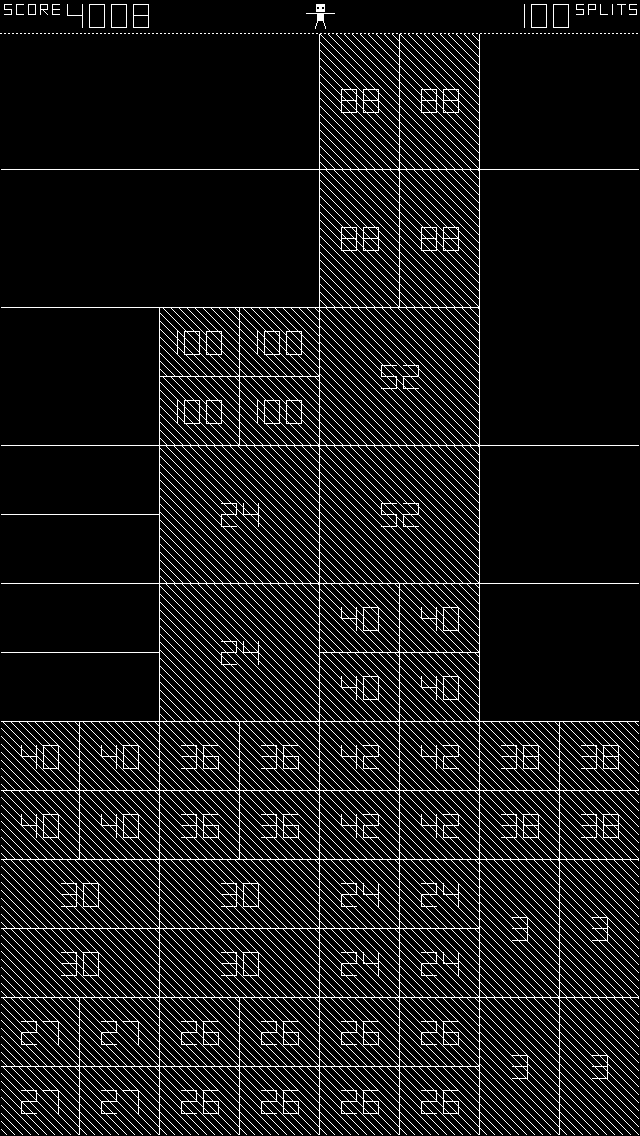
Title: SPL-T Developer: Simogo Platforms: IOS Universal Price: $2.99 --- If you follow mobile games, no doubt you're familiar with Simogo. Their games - from the haunting adventure game Year Walk to the enigmatic text-twisting Device 6 - are defined by how they use the touch interface and slick polished presentations to deliver unique and compelling narrative experiences. So at first glance, SPL-T doesn't appear to be a Simogo title. But as you learn its rules and master its intricacies, SPL-T reveals that it's as unique as any of their other games. Your first attempt at SPL-T is likely to be confusing. Its gameplay seems as simple as its minimal appearance. The core concept is that you need to gather points by splitting the screen into blocks. Splits alternate between horizontal and vertical divisions; by dividing an area into four or more equally-sized blocks, those blocks convert into "point blocks" marked with a number. That number indicates how many splits are required to remove those blocks from the screen.
Once you realize that those blocks disappear from the screen, SPL-T's hidden depth becomes apparent. When those blocks disappear, above blocks as well as new blocks fall down to fill in the gaps, allowing for new splits to be made. Adding to the mechanic is that point blocks that fall into an empty space have their split number halved, letting you remove them more quickly.
SPL-T evolves from a puzzler with seemingly little strategy into a game of careful planning. To earn a high score, you must be mindful of how the screen will affected several splits in the future and be careful not to create a scenario where mo more splits are possible. It's a tricky and surprisingly addictive challenge.
And not surprisingly, just like its simple puzzle mechanics blossomed with hidden depth, SPL-T is not as basic as it first appears. A plethora of secrets are waiting to be found within the game itself. To say more would spoil the mysterious nature of Simogo's puzzler, but rest assured that SPL-T might be more than just a block-splitting game.
With SPL-T, Simogo once again showcases its mastery of mobile puzzlers, delivering an engaging game hiding a strategic challenge behind its simple aesthetic.
Title: Lara Croft GO Developer: Square Enix Montreal Platforms: IOS Universal, Android Price: $4.99 --- I'll start with a confession: when I first saw the screenshots and footage of Hitman GO, my impressions weren't exactly positive. I'm a big fan of the stealth franchise and it seemed like such a weird direction to take. But then I played the game and realized it was a brilliant distillation of Hitman's stealth-puzzle DNA into an experience built from the ground up for mobile. So to say my hype and expectations for the Tomb Raider-themed follow-up were high would be an understatement.
Lara Croft GO not only exceeds those expectations, but also refines the turn-based puzzle template introduced in Hitman GO, all in a gorgeous isometric package. While Hitman GO presented its sneaky puzzles like a board game, Lara Croft GO sheds the tabletop veneer to deliver an action-puzzle adventure. The turn-based movement along paths remains, but it's no longer contained to flat surfaces and figurines. You guide Lara through ancient temples and dense jungle, past deadly traps and subterranean passages. This is an adventure in the full sense of the word, as levels flow together seamlessly and areas seen in the distance might be traversed several stages later.
Yes, traversal. The levels here are multi-tiered environments and Lara is as agile as ever, able to scale walls, shimmy along edges, and even pull off the occasional handstand. The handstand isn't the only callback to the main games; Lara's dual pistols return as well, as you deal with the numerous creatures found throughout GO's levels. Like in Hitman GO, you need to bump enemies from the side or back to kill them, but the combat is far more involved here. You might need to goad a lizard to chase you, or time your movement to avoid the poisonous fangs of a giant spider. Single-use spears let you skewer creatures from afar, and the environment is your greatest weapon, since traps and hazards can kill creatures.
However Lara Croft GO wouldn't be compete without environmental puzzles and all the elements you'd expect are here: pillars to push and pull, switches and pressure pads, platforms to raise. Given the turn-based nature of the gameplay, puzzles rely heavily on timing and figuring out the optimal path through the levels so you can avoid danger while activating switches or getting platforms into position. While the grids are smaller than the ones in Hitman, Lara Croft focuses more on interactive elements and environmental dangers to add challenge and variety to its puzzles.
Lara Croft GO visuals are just as impressive and polished as its gameplay. The board game aesthetic is gone, and in its place is a colorful isometric world filled with detail and life. Foliage sways in the breeze, lizards test the air with forked tongues, waterfalls drain out over cavernous drops. Each chapter, divided between different Mazes on your journey to a mysterious artifact, has a different visual tone, from the cliff-side ruins of the Maze of Snakes to the underground ruins and murky swamps of other levels. That visual polish even extends to the stylish menu and minimalist UI. An atmospheric soundtrack completes the engrossing presentation.
Lara Croft GO truly impressed me in how it adapted the turn-based puzzle gameplay seen in Hitman GO to Tomb Raider's platforming-heavy adventure. Once again, it distills the core aspects of a franchise - the exotic locations and ruins, the dangerous traps and creatures lurking within, environmental puzzles and agile climbing - into a mobile-friendly experience that's simple to control but still challenging and engaging.
If there's one gripe, it's that the game lacks the replay value of Hitman GO, with no collectibles that require extra puzzling to reach, optional challenges, or move pars to beat. There are gems and hidden relics to find, which in turn unlock new outfits, but those are hidden in the background rather than extra gameplay elements. But I imagine those elements would tarnish the atmosphere and adventure vibe, so perhaps the experience is better without those aspects.
Lara Croft GO can be purchased for $4.99 (Also on Android). --- *Okay, so Lara Croft GO is a slight deviation from the usual games I cover, but with a mobile game this good, I really wanted to share my impressions, and honestly I put it in the same category as Grow Home and Valiant Hearts, aka games from larger publishers that are more indie game-esque than their usual work.
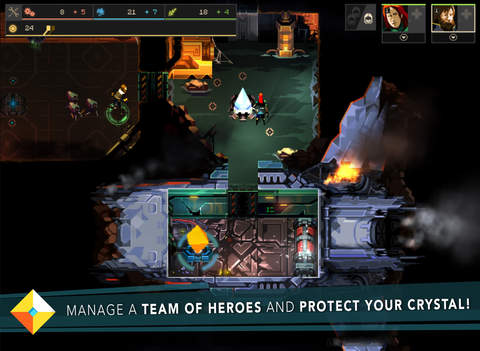
Some games are laser focused on a single aspect, fine-tuning a mechanic or element to perfection. The reflex-testing evasion of Super Hexagon or the fourth wall-breaking storytelling of The Stanley Parable. And then you have games that straddle numerous genres, like the deck-building action brawler Hand of Fate or A Dark Room. Dungeon of the Endless fits firmly in the latter category: a sci-fi dungeon-crawling, tower-defense, squad-based roguelike that blends aspects of those genres to deliver a challenging and unique experience.
Dungeon of the Endless starts out bad for your team of bounty hunters, assassins, and criminals, as their prison transport vessel is destroyed by the mysterious alien force known as the Endless. And it only gets worse from there, as the escaped survivors find themselves deep underground, in the subterranean corridors of an Endless complex. Alien monstrosities lurk in the dark rooms and halls, waiting to attack your heroes in overwhelming waves. The exit is twelve floors up, past industrial tunnels, dilapidated research facilities, and organic hives.
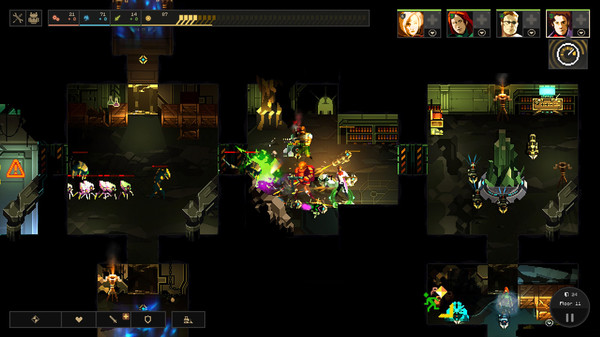
The easiest way to describe Dungeon of the Endless is to break its gameplay down by its individual elements. Each floor is a procedurally-generated maze, and you guide your team room-by-room, searching for the level exit. You never know what awaits behind the next door. Much-needed resources, a merchant, a new hero to recruit, more ruthless enemies?
While you can't choose your heroes' actions directly, you must still use their skills intelligently to make it out alive. Some wield powerful guns but move slow, while others slice enemies down with blades and spears and run quickly. Special abilities can boost damage and speed, regenerate health, among other useful buffs.
But your team alone isn't strong enough to survive the Endless. Each room is peppered with slots where you can place various modules. These act like the towers in a tower defense game, each with different offensive, defensive, and support capabilities. However, you can only place modules in powered rooms, and that's where the true challenge emerges.
Power is emitted by the Crystal; if it's destroyed, then all hope is lost. Upon finding the level exit, you must transport the Crystal there. In this phase, the cautious room-by-room approach morphs into a desperate escort mission as you designate one person to carry the Crystal. The rest of your team must protect that defenseless hero as relentless waves of enemies endlessly spawn from every un-powered room. You never have enough power to illuminate all the rooms so pre-planning is crucial. Did you place enough modules? Which route will you take, which rooms will you power up? Which hero will guard the rear, which one will rush ahead to guard the carrier?
All of the game's varied elements mesh together at that moment. The cautious dungeon crawling to find the exit, the tower-defense aspect as you build modules for support along your route, and the squad tactics as you lead your team out of the level.
Surviving in Dungeon of the Endless is always thrilling, tense, and challenging, and discovering the synergies between modules and heroes is equally rewarding. A varied array of modifiers adds replay value, including an endless mode, a hardcore mode, and other twists on the core gameplay. The game controls flawlessly on touchscreen, joining the likes of FTL and Paper's Please as examples of excellent PC ports.
Dungeon of the Endless is available for $4.99 on iPad.
Title: Manowar Developer: Lachlan Nuttall Platforms: IOS Universal Price: $1.99 --- A swaying ship, cannons, and a colorful assortment of cannonballs. That's all Manowar needs to deliver a tricky and satisfying puzzle game.
At its core, Manowar is a simple game. Each level presents you with an interior of a ship at sea, filled with various platforms, barriers, and cannonballs, and lined with cannons. The goal is to tilt the ship back and forth, maneuver the cannonballs into position, and fire them into the surrounding watery abyss.
But that's only the start. as new mechanics compound to create suprisingly devious challenges. Firing a cannon cause the remaining cannonballs onboard to bounce into the air, allowing you to get them over walls or balance them atop other cannonballs. Then the game adds colored cannons that only affect cannonballs of the same hue. And then barriers that can only be crossed from certain directions, then platforms that swing in specific patterns, and then portals, and so on.
All these mechanics turn Manowar into a puzzler with a focus on timing and careful planning. Moving and firing cannonballs without thinking of how it will affect the remaining cannonballs can easily led to having one stuck without a way to maneuver it. You may need to block passages to guide cannonballs along a certain route or fire colored cannonballs in a specific sequence, among other tricky scenarios.
Manowar remains challenging through its 48 levels, and the game's polished presentation compliments its equally polished puzzle design. You can purchase Manowar for $1.99.
Title: Prune Developer: Polyculture Platforms: IOS Universal Price: $3.99 --- Mobile is home to wide variety of genres, and games like Shadowmatic, Zen Bound, and Monument Valley have shown how relaxing tactile experiences are well suited for the platform. The recently released Prune drives that point home, delivering a wonderfully artistic puzzler that's a worthy addition to any mobile library. Grow a tree, lead it to the light and watch its flowers bloom: that's the core concept of Prune across the game's five chapters. Swiping on the screen lets you slice away branches and steer the growing tree towards the light, through narrow passages, and around obstacles. From red spheres that infect your tree to windswept landscapes, gates and switches, and pollination, Prune's zen veneer blossoms into a surprisingly tricky puzzler in later levels as new and interesting elements are introduced.
Prune is as enjoyable to watch as it is play. Watching your tree sprout and reach out with twisting branches towards the light is always satisfying; combined with the shadowy landscapes with red sun and stars overhead, Prune is art in motion. Even the game's menu is elegant, as you spin the earth to switch chapters, the stars streaking by and the ground eroding with the passage of time.
Prune's freeform gameplay makes it fun to replay, or just sit back and enjoy the artistic experience. You can purchase Prune for $3.99.
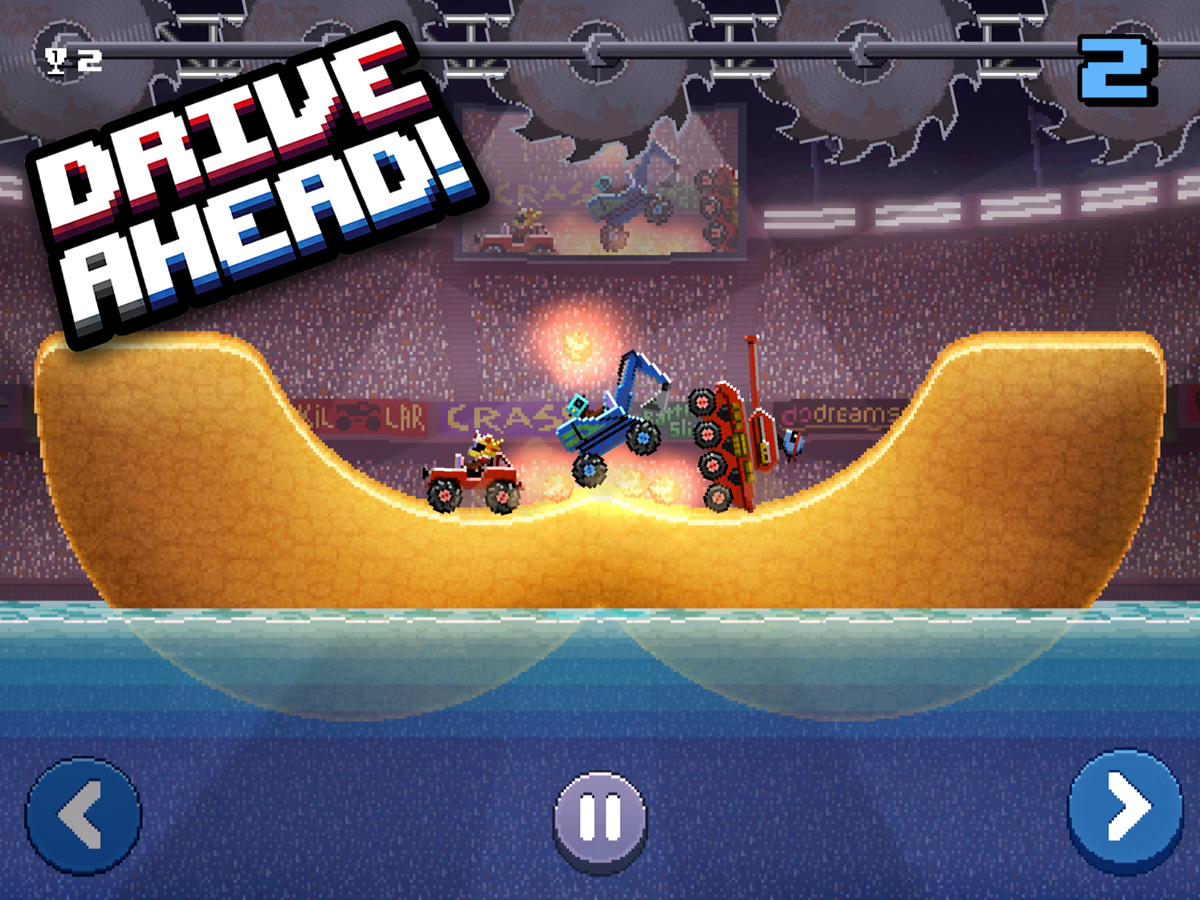
Title: Drive Ahead! Developer: Dodreams Game Studio Platforms: IOS Universal Price: Free --- Between games like Wrestle Jump, Badland, and others, mobile has a nice selection of fun local multiplayer games. I'm glad I recently discovered Drive Ahead, because it's a polished and fun addition to that list. Most reminiscent of Wrestle Jump, Drive Ahead has you controlling a vehicle in wild and unusual arenas with the goal of smashing your opponent's head to earn points. It's simple and hectic, but the sheer variety of vehicles and arenas is what makes Drive Ahead stand out from similar titles. From go-karts, limos, and FI cars to tanks, garbage trucks, forklifts, and more, a sizable array of vehicles are available, each controlling differently due to their size, speed, and shape. The arenas are just as varied, ranging from simple islands with ramps to see-saw platforms. The matches only last a few seconds before entering a "sudden death" state where a random hazard appears, like descending saw blades or fireballs.
It's the little touches that give Drive Ahead its charm. A hurt driver on stretcher slides out of the back of the ambulance, bottles fall from the garbage truck when it flips upside down, and churning tires kick up dust and dirt as they barrel around the arenas. If you don't have a friend to battle, the game offers a nice selection of single player modes, including classic fights against the AI, a mission mode with various objectives, and King of the Hill. The developers have been consistently updating Drive Ahead with new arenas and new vehicles.
Drive Ahead is free with optional and unobtrusive IAP. You can download the game here.